Nutrition
Best Nutrition Courses in India: What Should You Look For?
- By
- NHHA Editorial
- Published
- Reading time
- 21 min
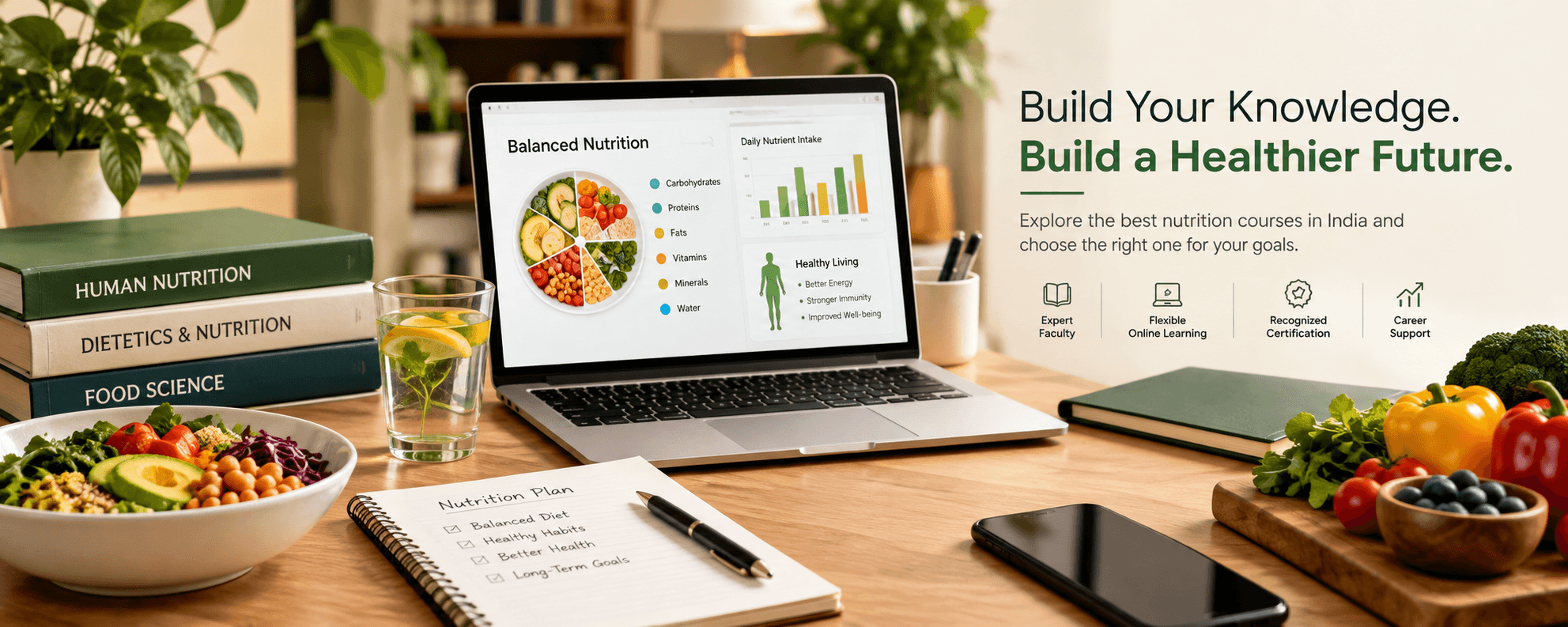
Choosing a nutrition course can be confusing. Learn what to compare before enrolling, including curriculum, practical training, case studies, certification and career support.
Best Nutrition Courses in India: How to Choose the Right One for Your Career
Nutrition is becoming an increasingly important part of conversations around health, fitness, disease prevention, and overall well-being. As more people recognize the relationship between food and health, the demand for qualified nutrition professionals is growing across wellness centres, fitness facilities, healthcare organizations, online consultation platforms, and nutrition education businesses.
For students, working professionals, fitness enthusiasts, and individuals looking to build a career in nutrition, enrolling in a nutrition course can be an important first step. However, with so many online nutrition courses, nutrition certification programs, and dietetics courses available in India, choosing the right one can be confusing.
Not every course offers the same level of education, practical exposure, faculty support, or career opportunities. Some focus primarily on theoretical knowledge, while others include case studies, supervised practice, consultation skills, and real-world applications.
Before enrolling, it is important to understand what a course teaches, how the learning process works, what certification it provides, and whether the program aligns with your professional goals. A well-chosen course can help you develop a stronger understanding of nutrition science and prepare you to apply that knowledge responsibly in relevant professional settings.
This guide explains the key factors to consider when comparing nutrition courses in India and provides a practical checklist to help you make a more informed decision before investing your time and money.
1. Identify Your Career Goals Before Choosing a Course
The first step in selecting a nutrition course is understanding why you want to study nutrition. Different programs are designed for different learning needs, and the right choice depends on your current qualifications, interests, and future plans.
For example, a student interested in building a professional career in dietetics may require a more comprehensive academic program than someone who wants to understand the fundamentals of healthy eating or improve their knowledge as a fitness professional.
Before comparing courses, consider the following questions:
- Do you want to develop a professional career in nutrition or dietetics?
- Are you interested in sports nutrition, weight management, clinical nutrition, or general wellness?
- Do you need a beginner-friendly course or an advanced program?
- Are you looking for flexible online learning alongside your current job or studies?
- Do you want to develop skills in client consultations, nutrition education, or wellness coaching?
- Will you need practical training or supervised experience to achieve your career goals?
Answering these questions will help you narrow down the available options.
For example, someone interested in sports nutrition should look for a curriculum that covers exercise physiology, energy requirements, hydration, recovery, and sports-related dietary planning. Someone interested in clinical dietetics should investigate programs with appropriate academic depth, relevant supervised clinical exposure, and eligibility pathways for their intended role.
The key is to choose a course based on the knowledge and skills you need, rather than selecting one simply because it is popular or advertised as a certification program.
2. Examine the Curriculum in Detail
The curriculum is one of the most important factors to evaluate when comparing nutrition courses. It determines what you will learn, how deeply the subjects are covered, and whether the program provides a strong foundation for further study or professional development.
A comprehensive nutrition curriculum should explain the scientific principles behind food, nutrients, digestion, metabolism, and their relationship with human health.
Depending on the course level and specialization, useful subjects may include:
- Fundamentals of nutrition: Understanding carbohydrates, proteins, fats, vitamins, minerals, water, and their functions in the body.
- Human physiology: Learning how major body systems function and how nutrition influences normal physiological processes.
- Food science: Exploring food composition, preparation methods, nutrient retention, food quality, and food safety.
- Diet planning: Understanding energy requirements, dietary assessment, portion sizes, meal planning, and balanced eating patterns.
- Lifecycle nutrition: Studying nutritional needs during childhood, adolescence, adulthood, pregnancy, and older age.
- Clinical nutrition: Learning the principles of nutrition care in health conditions, with the depth and scope appropriate to the qualification.
- Public health nutrition: Understanding community nutrition, nutrition education, food security, and population-level health initiatives.
- Specialized nutrition: Exploring areas such as sports nutrition, weight management, digestive health, or other subjects relevant to the program.
Do not rely only on the list of subjects displayed on a course website. Check how each topic is taught, whether the modules include assessments, and whether the curriculum is updated regularly.
A course with a long syllabus is not automatically better than one with fewer, carefully structured modules. Look for clear learning objectives, logical progression, scientific accuracy, and a suitable balance between theory and application.
3. Look for Practical Training and Real-World Application
Nutrition is a field in which applying knowledge is just as important as understanding concepts. Knowing the functions of nutrients is useful, but translating that knowledge into appropriate dietary guidance requires additional skills.
Practical training helps learners understand how nutrition principles can be used in realistic situations.
When comparing nutrition certification programs, investigate whether they include activities such as:
- Calculating and interpreting dietary requirements.
- Reviewing food diaries and dietary recall records.
- Understanding nutritional assessment methods.
- Preparing balanced meal plans for different needs.
- Evaluating food labels and ingredient lists.
- Learning portion estimation and meal composition.
- Practicing nutrition education and communication.
- Working through structured case studies.
- Receiving feedback on assignments and practical exercises.
Some programs may also offer supervised practical placements, demonstrations, workshops, or simulated consultations.
Before enrolling, ask how much practical work is included and how your performance will be evaluated. A course that provides meaningful feedback can help you identify gaps in your understanding and improve your confidence.
It is also important to distinguish between recorded demonstrations, simulated exercises, and supervised work with real clients. These experiences are not equivalent, and the course provider should clearly explain what is included.
For learners planning a professional career, practical exposure should be evaluated alongside academic depth and the eligibility requirements of the intended role.
4. Evaluate the Quality of Case Studies
Case studies help bridge the gap between textbook knowledge and practical decision-making. They encourage learners to examine different situations, identify relevant information, and apply nutrition principles in a structured way.
A useful nutrition course should ideally include case studies that reflect the needs of its intended learners.
For example, a beginner-level program might use cases involving balanced meals, food preferences, portion sizes, and general dietary habits. An advanced program may explore more complex nutritional assessments, dietary modifications, or multidisciplinary care scenarios.
Depending on the course, case studies could cover:
- Creating balanced meal plans for different age groups.
- Understanding dietary patterns associated with common nutritional concerns.
- Evaluating the nutritional quality of everyday meals.
- Adapting meal plans to cultural preferences and food availability.
- Exploring nutrition considerations for physically active individuals.
- Reviewing anonymized scenarios involving specific health conditions.
- Communicating evidence-based nutrition information to clients.
The value of a case study depends on how it is structured. Simply reading a scenario is less useful than analysing it, explaining your reasoning, proposing an appropriate approach, and receiving feedback.
Ask whether the course includes guided case discussions, assignments, instructor reviews, or opportunities to explain your decisions.
Case studies should also teach learners to recognize their limitations. Complex medical conditions may require qualified healthcare professionals, and nutrition advice should remain within the learner's education, competence, and legal scope of practice.
5. Check the Faculty's Qualifications and Teaching Experience
The people teaching a course can significantly influence the quality of your learning experience. Qualified instructors should have relevant subject knowledge, the ability to explain complex concepts clearly, and an understanding of how nutrition principles are applied in practice.
Before enrolling, review the faculty profiles available on the course website.
Look for information about:
- Academic qualifications in nutrition, dietetics, or related disciplines.
- Relevant professional experience.
- Teaching and mentoring experience.
- Areas of specialization.
- Research, publications, or evidence-based professional work where relevant.
- Experience in practical nutrition education or consultation.
Do not evaluate faculty members only by their social media presence or promotional claims. Professional credentials, relevant experience, and transparent information about their roles are more useful indicators.
It is also worth checking whether instructors are directly involved in teaching and assessment or whether most of the program consists of pre-recorded material with limited support.
If the course includes live classes, find out whether you can ask questions, participate in discussions, and receive clarification when you find a topic difficult.
Good teaching should help learners understand not only what a nutrition principle is, but also why it matters and how to apply it responsibly.
6. Compare Live Classes, Recorded Lectures, and Learning Flexibility
Online nutrition courses offer flexibility, making them attractive to students, working professionals, and people managing multiple responsibilities. However, online programs can differ considerably in their learning structure.
Some offer recorded lectures that can be accessed at any time, while others include scheduled live classes, interactive workshops, assignments, and instructor-led discussions.
Recorded classes can be useful if you need to study at your own pace, revisit difficult topics, or fit learning around your existing schedule. Live sessions may be more suitable if you benefit from real-time explanations, discussions, and direct interaction with instructors.
Before choosing an online nutrition course, consider the following:
- Are recorded lectures available for revision?
- Are live classes scheduled in advance?
- Can you ask questions during or after sessions?
- Are lecture notes, reading materials, and other resources provided?
- Is there a learning management system to track your progress?
- Can you access the content after completing the course?
- Are assignments and assessments included?
- Is technical support available if you experience access problems?
The best learning format depends on your individual needs. However, flexibility should not come at the expense of educational quality.
A well-organized online course should provide clear learning objectives, structured modules, regular assessments, and appropriate opportunities to interact with instructors or seek academic support.
7. Understand the Certification and Accreditation
Certification is an important consideration when comparing nutrition courses, but the word itself does not guarantee a particular level of education or professional recognition.
Different programs may provide a certificate of completion, a private training certificate, an academic qualification, or a credential recognized by a relevant professional or regulatory body. These credentials can have very different purposes and levels of recognition.
Before paying for a course, investigate exactly what qualification you will receive.
Check the following details:
- The name of the institution issuing the certificate.
- The qualification or certificate title.
- The duration and level of the program.
- Whether the course has relevant accreditation or formal recognition, where applicable.
- Whether the institution's recognition claims can be independently verified.
- Whether the certificate is accepted for your intended academic or professional pathway.
- Whether additional qualifications, supervised practice, or examinations are required for your career goals.
Be cautious about claims such as guaranteed employment, internationally recognized certification, or eligibility to practise in a clinical setting unless the provider can clearly substantiate them.
A certificate from a short online course may demonstrate that you completed a particular learning program, but it does not automatically establish eligibility to practise as a dietitian or provide specialized clinical care.
If your goal is to work in a regulated or qualification-dependent role, verify the applicable requirements before enrolling. The course provider should be transparent about what the qualification does and does not permit you to do.
8. Evaluate Consultation Training and Communication Skills
For learners interested in working directly with clients, nutrition knowledge must be supported by effective communication and consultation skills.
A nutrition professional may need to understand a client's eating habits, food preferences, lifestyle, budget, cultural background, goals, and barriers to change. Communicating recommendations clearly and respectfully is an important part of this process.
Courses designed for client-facing roles may include training in:
- Conducting structured nutrition interviews.
- Collecting dietary histories and food records.
- Asking appropriate follow-up questions.
- Explaining nutrition concepts in accessible language.
- Developing realistic and culturally appropriate dietary recommendations.
- Setting measurable and achievable goals.
- Supporting habit formation and long-term consistency.
- Maintaining confidentiality and professional boundaries.
- Recognizing when a client needs referral to another qualified professional.
Look for opportunities to practise these skills through role-play, simulated consultations, supervised sessions, or structured assignments.
A course should also address ethical communication. Nutrition professionals should avoid unrealistic promises, misleading claims, unnecessary food restrictions, and advice that exceeds their qualifications.
Consultation training is particularly valuable for learners who plan to work in wellness services, nutrition education, or other client-facing settings. However, the level of training required will depend on the intended role and its professional requirements.
9. Review Assignments, Assessments, and Feedback
Assignments and assessments help learners understand whether they have actually mastered the material. Watching lectures without testing your understanding may make it difficult to identify gaps in knowledge.
When comparing dietetics courses and online nutrition certification programs, check how learning progress is evaluated.
Useful assessment methods may include:
- Module-wise quizzes.
- Written assignments.
- Nutrition calculations and dietary analysis.
- Meal-planning exercises.
- Case-study submissions.
- Presentations or group discussions.
- Practical demonstrations.
- Final examinations or capstone projects.
The assessment format should be appropriate for the course level and learning objectives.
Feedback is equally important. A quiz that provides only a score may be useful for revision, but detailed instructor feedback can help you understand why an answer is incorrect and how to improve your approach.
Ask whether assignments are reviewed by instructors, how long feedback usually takes, and whether learners have opportunities to clarify mistakes.
A structured assessment process encourages consistency and helps learners build confidence before applying their knowledge in real-world situations.
10. Investigate Career Support and Professional Development
Many people enrol in nutrition courses because they want to explore career opportunities or develop skills that complement their existing work. In these cases, career relevance should be an important part of the selection process.
Depending on the qualification and the learner's background, nutrition-related opportunities may include nutrition education, wellness program support, health content creation, fitness-related nutrition education, research assistance, or further academic study.
Some qualified professionals may also pursue roles in clinical dietetics, community nutrition, or specialized nutrition services when they meet the relevant educational and professional requirements.
When evaluating a course, investigate whether it provides:
- Career guidance or mentoring.
- Resume and interview preparation.
- Internship or placement assistance.
- Portfolio-building assignments.
- Professional networking opportunities.
- Guidance on further qualifications.
- Support for developing educational content or workshops.
- Information about the skills expected in relevant job roles.
If a course advertises placement assistance, ask what that means in practice. Does it offer interview preparation, introductions to employers, internship opportunities, or a formal placement process?
Do not assume that career assistance guarantees employment. Your career outcomes will also depend on your prior education, experience, practical skills, location, and the requirements of the role you pursue.
The most useful program is one that clearly explains how its learning outcomes connect with realistic professional pathways.
11. Compare Course Duration, Fees, and Overall Value
Course fees are an important consideration, but the lowest-priced option is not always the best value. Similarly, a more expensive program is not automatically more comprehensive or credible.
Instead of comparing prices alone, evaluate what you receive for the total cost.
Consider the following factors:
- Total course duration and expected weekly study time.
- Number of modules and depth of the curriculum.
- Access to live classes and recorded lectures.
- Practical assignments and case-study training.
- Instructor interaction and feedback.
- Examination or assessment fees.
- Learning materials and additional resources.
- Certificate issuance charges.
- Access to course content after completion.
- Refund, cancellation, and payment policies.
Ask for a clear breakdown of the total amount payable before enrolling. Some providers may advertise an introductory fee while charging separately for examinations, certificates, or other services.
It is also worth comparing the time commitment with your personal and professional responsibilities. A demanding program may offer substantial learning opportunities, but only if you can realistically complete its requirements.
A useful way to assess value is to compare the learning outcomes, practical exposure, instructor support, and relevance to your goals against the total cost.
12. Look for Scientific Accuracy and Evidence-Based Teaching
Nutrition is an evolving field, and reliable education should be grounded in scientific evidence rather than unsupported claims or short-lived trends.
A good course should explain the difference between established evidence, emerging research, and areas where scientific understanding remains uncertain.
Before enrolling, examine the provider's educational approach.
Look for programs that:
- Refer to credible scientific literature and established nutrition guidance.
- Explain the reasoning behind nutrition recommendations.
- Avoid promising rapid or guaranteed health outcomes.
- Recognize that nutritional needs vary between individuals.
- Teach learners to assess information critically.
- Discuss the limitations of nutrition studies.
- Update course material when important evidence changes.
Be cautious if a course promotes a single diet as the solution for everyone, makes exaggerated claims about curing diseases, or relies heavily on fear-based messaging.
Nutrition education should encourage critical thinking and responsible decision-making. Learning how to evaluate evidence is particularly important for anyone who intends to educate the public, create nutrition content, or work with clients.
13. Read Reviews and Verify the Course Provider
Course descriptions and promotional materials can help you understand what a program offers, but they should not be your only source of information.
Before making a payment, research the institution and look for independent information about the learning experience.
Useful steps include:
- Reading detailed learner reviews across multiple sources.
- Checking the institution's official website and faculty profiles.
- Reviewing sample lessons or course demonstrations.
- Asking for a sample syllabus.
- Confirming the identity of the certificate-issuing organization.
- Checking whether practical training is genuinely included.
- Contacting the provider with specific questions.
- Reviewing the terms and conditions before paying.
Pay attention to the details in learner feedback. Comments about instructor responsiveness, course organization, assignment quality, and access to learning materials may be more informative than a simple star rating.
You can also ask the institution to explain what happens if you cannot complete the course on time, whether you can pause your studies, and how academic support works.
A credible provider should be willing to explain its program clearly and answer reasonable questions without pressuring you to make an immediate payment.
14. Common Mistakes to Avoid When Selecting a Nutrition Course
Even motivated learners can choose a program that does not meet their expectations. Avoiding a few common mistakes can help you make a more informed decision.
Choosing based only on price: A low fee may be attractive, but check the quality of teaching, curriculum, practical work, and support before making a decision.
Believing every certificate offers professional recognition: Certificates differ in purpose and recognition. Confirm whether the qualification meets the requirements of your intended career pathway.
Ignoring practical training: Theoretical knowledge is essential, but learners pursuing applied roles may also need supervised practice, case studies, and communication training.
Relying entirely on advertisements: Marketing claims should be verified through the syllabus, faculty information, sample lessons, and written course policies.
Overlooking the time commitment: A course that does not fit your schedule may be difficult to complete, even if the subject matter is excellent.
Expecting guaranteed employment: A course may provide useful skills and career support, but no certificate alone can guarantee a job or professional success.
Choosing a course without a clear goal: Before enrolling, identify whether you want foundational knowledge, further academic education, a specialized skill, or preparation for a particular professional role.
Taking time to evaluate these factors can help you avoid unnecessary expenses and choose a program that supports your long-term learning objectives.
15. Checklist Before Enrolling in a Nutrition Course
Use the following checklist to compare programs before paying the course fee.
Curriculum and Learning
- The syllabus is available and clearly explained.
- The modules match my current knowledge and learning goals.
- The curriculum covers relevant nutrition science in sufficient depth.
- The course includes assignments, assessments, or practical exercises.
- The teaching materials are scientifically sound and appropriately updated.
Practical Exposure
- Case studies are included where relevant.
- Practical activities have clearly defined learning outcomes.
- I understand whether training is simulated, supervised, or conducted with real clients.
- Feedback is provided on assignments or practical work.
- Consultation training is included if it is relevant to my goals.
Faculty and Learning Support
- Instructor qualifications are clearly stated.
- I know whether classes are live, recorded, or a combination of both.
- I understand how to ask questions and receive support.
- The learning platform and course schedule suit my routine.
Certification and Career Relevance
- I know exactly which institution issues the certificate.
- Recognition and accreditation claims have been verified.
- I have checked the qualification requirements for my intended career.
- The course does not make unsupported employment or income guarantees.
- Any advertised career support is clearly explained.
Fees and Policies
- The total cost, including additional charges, is clear.
- The duration and expected weekly workload are manageable.
- Refund and cancellation policies have been reviewed.
- Course access and certificate requirements are clearly stated.
- I have reviewed available samples, reviews, or course demonstrations.
If several important questions remain unanswered, contact the provider before enrolling. A transparent institution should be able to explain the course structure, learning outcomes, costs, and limitations.
16. How to Choose a Course Based on Your Learning Needs
There is no single nutrition course that is ideal for every learner. The right program depends on your background and the role you want to pursue.
For beginners: Look for a course that introduces nutrition fundamentals, explains key concepts clearly, and provides structured assessments. Check whether it is suitable for learners without prior nutrition education.
For students pursuing a nutrition career: Prioritize academic depth, relevant qualifications, practical exposure, and clear pathways to further education or professional opportunities.
For fitness professionals: Consider programs covering exercise nutrition, energy balance, hydration, recovery, and the boundaries between general nutrition education and individualized clinical care.
For working professionals: Look for flexible schedules, recorded classes, manageable workloads, responsive academic support, and transparent assessment requirements.
For aspiring nutrition educators and content creators: Consider courses that develop evidence evaluation, communication, nutrition literacy, and the ability to explain scientific information accurately to different audiences.
For individuals interested in client consultations: Evaluate programs that include communication skills, dietary assessment, case studies, ethical practice, and appropriate supervised training. Confirm that the qualification matches the scope of work you intend to perform.
Comparing courses in this way can help you focus on programs that match your needs instead of becoming overwhelmed by the number of available options.
Conclusion
Choosing among the best nutrition courses in India requires more than comparing course names, promotional offers, or certificate designs. It involves understanding the curriculum, evaluating practical training, reviewing faculty qualifications, examining assessment methods, and verifying the recognition and relevance of the qualification.
A strong nutrition education program should help learners develop scientific understanding, apply concepts thoughtfully, evaluate evidence, and communicate responsibly. For those planning a professional career, it is equally important to verify the educational and practical requirements associated with their intended role.
Before enrolling, take time to compare at least two or three programs using the checklist in this guide. Review the complete syllabus, ask questions about practical exposure, calculate the total cost, and confirm what the certificate actually represents.
Most importantly, choose a course that aligns with your current qualifications and long-term goals. A thoughtful decision can help you build a stronger foundation in nutrition, identify opportunities for further learning, and take more confident steps toward your chosen career path.
Frequently Asked Questions (FAQs)
1. Which nutrition course is best in India?
The best course depends on your educational background and career goals. Compare the curriculum, practical exposure, faculty, qualification, and professional relevance before deciding.
2. Can I study nutrition online?
Yes. Many institutions offer online nutrition courses through recorded lectures, live classes, assignments, and virtual learning platforms. Check whether the program provides enough interaction and practical learning for your needs.
3. What should I check before enrolling in a nutrition certification course?
Review the syllabus, instructor qualifications, practical training, case studies, assessment methods, total fees, certificate issuer, and recognition claims.
4. Does a nutrition certificate qualify me to work as a dietitian?
Not necessarily. A short certificate may provide foundational knowledge, but professional eligibility depends on the relevant qualifications, training, and requirements for the role. Verify these requirements before enrolling.
5. Are practical sessions important in nutrition courses?
Yes, particularly for learners pursuing applied or client-facing roles. Practical exercises, case studies, and appropriate supervised experience can help learners develop skills beyond theoretical knowledge.
6. How much does an online nutrition course cost in India?
Fees vary according to the institution, duration, curriculum, level of qualification, and practical training included. Compare the total cost and learning outcomes rather than choosing based on the advertised price alone.
7. How can I check whether a nutrition course is credible?
Review the official syllabus, faculty credentials, certificate issuer, accreditation claims, assessment structure, and independent learner feedback. Ask the provider to clarify any claims you cannot verify.
8. Do nutrition courses offer job placement?
Some programs offer career guidance, internships, or placement assistance, while others focus only on education. Confirm the exact services offered and remember that career outcomes depend on your qualifications, skills, and the requirements of the role.
Enroll now and book your seats
Filed under
- nutrition course
- online nutrition course
- nutrition certification
- dietetics course
- career course